I've been thinking about starting to blog again.
... just thought I'd throw that out there.
Tuesday, August 22, 2006

Monday, May 08, 2006
a mélange: my blog portfolio
The end of this semester seems a little surreal to me. In a week most of my friends and my sister will graduate, and I'll have to start seriously thinking about what comes after my own graduation in the next year. It's kind emotional actually.
I've been using this extremely emotionally-aware mood to reassess my semester as a whole. In particular, I think my blog is a physical representation of how I operate in any given class, and it's a tangible chart of learning and progress. To prove this idea, I've created a blog portfolio.
Complied below is a collection of what I consider my best and worst blog posts. Please observe the dates of the posts - you'll see a steady improvement in the work, albeit with a few bumps and lags along the way. I've also included a couple of comments I made on others' blogs.
I know I've grown as a blogger and a person through Blogging in Theory and Practice this semeseter. With this portfolio, I hope you will be able to see that, too.
In the Beginning
Before we delve into the goods and bads of my blog, I think it's to go back and look at my ideas of blogging at the beginning of the semester.
43 pages (30/01)
Here's the post that declared the topic of my blog. I've included it in this portfolio as a reminder of the purpose I declared in January. After reading it, you can see that I've consistently adhered to that quotation framework.
reflections (24/01)
This was my very first post. Before this class, I had a very negative view of blogging. Back then I equated blogging with online journaling, which I thought (and still think) was egotistical to write and boring to read. The first couple of blogging classes, however, really set me straight. I think my biggest realization has been that blogging is not just a writer's soap-box. It's a method of communication and the blogosphere is a community.
And a Blogger was Born
So now that we know where I started out, we can look at my journey into the blogosphere. I've listed a few posts that display my development as a blogger. Also, the number of links in these posts make them very "blog-like" as we defined in class.
ode to a bashful blogger (02/02)
Like I said before, I used to be opposed to blogging. The reasons I listed in reflections, are the public ones I cite in conversation. In "ode", though, I came out with a more personal problem: intense shyness. Early on in the semester, I realized that one of the virtues of blogging is that one can, to paraphrase Anne Lamott, stay at home and still be famous. Blogging is a great medium for those who have a lot to say, but maybe don't want to say it out loud in traditional mediums.
blogging/bleeding (04/03)
I admittedly strayed from my theme of quotations in this post, but I don't think the deviation takes away from its meaning. The main idea of this post - that blogging is a positive outlet for self-expression - is consistent with that of "ode to a bashful blogger." This time, however, I took the concept one step further and applied it to our discussion of teens and blogging.
a tango (21/02)
This post was inspired by our in-class reading and discussions of the relationship between blogging and journalism. I'm a journalism major, and at the beginning of the semester I'd had a hard time figuring out how I felt about blogging as journalism, and vice versa. In this post, I finally pin down my feelings about blogging and journalism by applying what I've learned about both mediums.
Learning to Talk...
Writing with a strong voice is one of the main characteristics of a blog post. Blogging with voice has been one of my greatest strengths this semester, and below I've listed three posts as examples. I also consider these some of my best and favorite work. When reading these posts, you'll notice that there is a certain sense of immediacy in each one. This shows the feeling with which I wrote each post, and thus the voice.
all around the limbo world (08/02)
today for you (22/02)
karma karma karma karma chameleon (07/03)
...And to Walk
It wouldn't be fair if I didn't note some of the posts where I stumbled over words and meaning. Below I listed two posts that don't represent my best work, two bad posts. Both of these posts felt incredibly forced as I wrote them. I simply wasn't "feeling" the topic of either, but wrote regardless, knowing that I had to fulfill the assignments since this blog was for a grade.
fair dinkum (11/03)
This post was an effort to fulfill the assignment to write about the art forms discussed in class and our reading.
novel ideas (07/04)
Here, frankly, I was desperately looking for a topic to blog and post about.
Becoming Part of the Community
A big part of being a blogger is being a part of the blogosphere. This means keeping up with your own blog as well as commenting on others'. I've made many comments on many blogs - not just my classmates' - this semester, so I chose two examples.
The first is a comment on a post from The Hamster's Wheel, "It's my religion, not my lifestyle." This post received a lot of comments, which makes it hard to not simply repeat what has already been noted in the virtual conversation. I chose to echo others' sentiments while providing my own.
The second is a comment I made on my own blog. Donna offered some interesting insights on my post "triple fault," and I wanted to respond and elaborate. I felt the best place to do so was on my own blog. That way the conversation could continue in the future.
Out On My Own
And so my semester - and thus my portfolio - is at an end. I've learned a lot about blogging in this course, and, perhaps more importantly, blogging has allowed me to learn a lot about myself. I hope you've been able to see that through this mélange of my work. Cheers.
I've been using this extremely emotionally-aware mood to reassess my semester as a whole. In particular, I think my blog is a physical representation of how I operate in any given class, and it's a tangible chart of learning and progress. To prove this idea, I've created a blog portfolio.
Complied below is a collection of what I consider my best and worst blog posts. Please observe the dates of the posts - you'll see a steady improvement in the work, albeit with a few bumps and lags along the way. I've also included a couple of comments I made on others' blogs.
I know I've grown as a blogger and a person through Blogging in Theory and Practice this semeseter. With this portfolio, I hope you will be able to see that, too.
In the Beginning
Before we delve into the goods and bads of my blog, I think it's to go back and look at my ideas of blogging at the beginning of the semester.
43 pages (30/01)
Here's the post that declared the topic of my blog. I've included it in this portfolio as a reminder of the purpose I declared in January. After reading it, you can see that I've consistently adhered to that quotation framework.
reflections (24/01)
This was my very first post. Before this class, I had a very negative view of blogging. Back then I equated blogging with online journaling, which I thought (and still think) was egotistical to write and boring to read. The first couple of blogging classes, however, really set me straight. I think my biggest realization has been that blogging is not just a writer's soap-box. It's a method of communication and the blogosphere is a community.
And a Blogger was Born
So now that we know where I started out, we can look at my journey into the blogosphere. I've listed a few posts that display my development as a blogger. Also, the number of links in these posts make them very "blog-like" as we defined in class.
ode to a bashful blogger (02/02)
Like I said before, I used to be opposed to blogging. The reasons I listed in reflections, are the public ones I cite in conversation. In "ode", though, I came out with a more personal problem: intense shyness. Early on in the semester, I realized that one of the virtues of blogging is that one can, to paraphrase Anne Lamott, stay at home and still be famous. Blogging is a great medium for those who have a lot to say, but maybe don't want to say it out loud in traditional mediums.
blogging/bleeding (04/03)
I admittedly strayed from my theme of quotations in this post, but I don't think the deviation takes away from its meaning. The main idea of this post - that blogging is a positive outlet for self-expression - is consistent with that of "ode to a bashful blogger." This time, however, I took the concept one step further and applied it to our discussion of teens and blogging.
a tango (21/02)
This post was inspired by our in-class reading and discussions of the relationship between blogging and journalism. I'm a journalism major, and at the beginning of the semester I'd had a hard time figuring out how I felt about blogging as journalism, and vice versa. In this post, I finally pin down my feelings about blogging and journalism by applying what I've learned about both mediums.
Learning to Talk...
Writing with a strong voice is one of the main characteristics of a blog post. Blogging with voice has been one of my greatest strengths this semester, and below I've listed three posts as examples. I also consider these some of my best and favorite work. When reading these posts, you'll notice that there is a certain sense of immediacy in each one. This shows the feeling with which I wrote each post, and thus the voice.
all around the limbo world (08/02)
today for you (22/02)
karma karma karma karma chameleon (07/03)
...And to Walk
It wouldn't be fair if I didn't note some of the posts where I stumbled over words and meaning. Below I listed two posts that don't represent my best work, two bad posts. Both of these posts felt incredibly forced as I wrote them. I simply wasn't "feeling" the topic of either, but wrote regardless, knowing that I had to fulfill the assignments since this blog was for a grade.
fair dinkum (11/03)
This post was an effort to fulfill the assignment to write about the art forms discussed in class and our reading.
novel ideas (07/04)
Here, frankly, I was desperately looking for a topic to blog and post about.
Becoming Part of the Community
A big part of being a blogger is being a part of the blogosphere. This means keeping up with your own blog as well as commenting on others'. I've made many comments on many blogs - not just my classmates' - this semester, so I chose two examples.
The first is a comment on a post from The Hamster's Wheel, "It's my religion, not my lifestyle." This post received a lot of comments, which makes it hard to not simply repeat what has already been noted in the virtual conversation. I chose to echo others' sentiments while providing my own.
The second is a comment I made on my own blog. Donna offered some interesting insights on my post "triple fault," and I wanted to respond and elaborate. I felt the best place to do so was on my own blog. That way the conversation could continue in the future.
Out On My Own
And so my semester - and thus my portfolio - is at an end. I've learned a lot about blogging in this course, and, perhaps more importantly, blogging has allowed me to learn a lot about myself. I hope you've been able to see that through this mélange of my work. Cheers.
Tuesday, May 02, 2006
bull's eye
I worked as a TA for a leadership development class last year. Before the year began, the instructors asked my fellow TA and I complete an exercise that required us to name the quote by which we live. I selected:
The good grade boosted my mood for a lot of reasons. I'm amidst a hell-ish week during which I have to complete finals in all of my classes, so a good grade is a great confidence booster. Plus it takes a little bit of pressure off my score on the final test in that course.
Kind of ironically, the greatest reason to smile that grade gave me actually depresses me.
Honestly, I'm not very smart. School's hard for me. The thing is, long ago, I taught myself how to study. I learned that I can't start a paper or project the night before it is due and expect to get a good grade. I'm not smart by nature, but I know I can be with the right behaviors.
The frustrating thing is, people don't really get that about me. With the exception of my best friend and my mom, most of my friends are fooled by the intelligence I create. They think I'm naturally smart, and ride me for my study/read/write-in-advance habits. Most of the time, such chiding isn't a problem. I can brush it off and we'll laugh together.
That's hasn't been the case recently. While I was working on my big paper, a friend or two were actually annoyed at the fact that I prioritized research over recreation. They made fun of me for writing for so long, and asked that I stop talking about the project that currently consumed my life.
I 'spose it could have been witty banter, but it sure didn't feel like it. I took it personally, though I know I shouldn't let that kind of stuff get to me. I really felt hurt.
So, circling back 'round to the point, this good grade is a pass for a huge "told-ya-so." And when doesn't it feel good to say that?
What makes me sad, though, is that these friends made me feel so bad in the process. Good grades are almost always a boost of confidence, but the boost should be about personal ability. Now, thanks to my annoyed friends, my grade justifies my study habits and the resulting recent lack of a social life. I shouldn't need justification for such things in the first place.
In the end, I know I'll end up taking the safer, more mature route and just get over the hurt. I'll continue my behavioral-smarts - my perceived over-achievement - to get to the grade I'm actually aiming for.
For tonight, though, I'd like to paste this 97 (one of the highest grades in the class) on my fridge. And flip the bird to all the naysayers. While doing a little dance around their decent grades that are lower than mine.
(Good luck on finals, all. Cheers.)
“If you would hit the mark, you must aim a little above it.” ~Henry Wadsworth LongfellowI'm don't think I truly live by Longfellow's statement, although I probably did more so last year than I do now. But I think I've successfully been using that philosophy of achievement lately to get me through the end of the semester flood of tests, papers, finals and projects. Case and point: I spent about two weeks torturing myself/working on a major paper. I was a little unsure of whether I completed the assignment, but my teacher wasn't and gave a grade I am quite pleased with.
The good grade boosted my mood for a lot of reasons. I'm amidst a hell-ish week during which I have to complete finals in all of my classes, so a good grade is a great confidence booster. Plus it takes a little bit of pressure off my score on the final test in that course.
Kind of ironically, the greatest reason to smile that grade gave me actually depresses me.
Honestly, I'm not very smart. School's hard for me. The thing is, long ago, I taught myself how to study. I learned that I can't start a paper or project the night before it is due and expect to get a good grade. I'm not smart by nature, but I know I can be with the right behaviors.
The frustrating thing is, people don't really get that about me. With the exception of my best friend and my mom, most of my friends are fooled by the intelligence I create. They think I'm naturally smart, and ride me for my study/read/write-in-advance habits. Most of the time, such chiding isn't a problem. I can brush it off and we'll laugh together.
That's hasn't been the case recently. While I was working on my big paper, a friend or two were actually annoyed at the fact that I prioritized research over recreation. They made fun of me for writing for so long, and asked that I stop talking about the project that currently consumed my life.
I 'spose it could have been witty banter, but it sure didn't feel like it. I took it personally, though I know I shouldn't let that kind of stuff get to me. I really felt hurt.
So, circling back 'round to the point, this good grade is a pass for a huge "told-ya-so." And when doesn't it feel good to say that?
What makes me sad, though, is that these friends made me feel so bad in the process. Good grades are almost always a boost of confidence, but the boost should be about personal ability. Now, thanks to my annoyed friends, my grade justifies my study habits and the resulting recent lack of a social life. I shouldn't need justification for such things in the first place.
In the end, I know I'll end up taking the safer, more mature route and just get over the hurt. I'll continue my behavioral-smarts - my perceived over-achievement - to get to the grade I'm actually aiming for.
For tonight, though, I'd like to paste this 97 (one of the highest grades in the class) on my fridge. And flip the bird to all the naysayers. While doing a little dance around their decent grades that are lower than mine.
(Good luck on finals, all. Cheers.)
Saturday, April 29, 2006
actual learning
I love it when material in one class overlaps with that of another. Partly because it makes understanding easier for at least one of the subjects, but mainly because I feel like I'm actually learning something for a change.
Today, the overlap was between lessons in my sociology and blogging classes. A concept found in my soc reading, Frederick W. Taylor's "scientific management," was referenced in our blogging reading and discussion. Taylor, an engineer, applied scientific management to factory jobs, equating time with production and money. With that connection, Taylor found that time can be more easily measured and charted to be saved.
In sociology class, The Family, we apply this scientific management to how parents divvy up their time spent doing paid work and housework or child care. In Blogging in Theory and Practice, we apply scientific management to a discussion of blogs as grids and networks. In my stream of consciousness, I apply it to the separation of my homes.
You see, my relationship with where I grew up has changed since I was a freshman in college, and I think that change has caused some unrest in my relationships with family members. But I think a variation of the sociological scientific management can be used explain it.
When I was a freshman I didn't consider Mizzou "home." My college life served a merely functional purpose. I didn't have close friendships here, nor did I have any sentimental feelings toward Columbia itself. Mizzou is where I did work, and that was it. So it made sense that I still placed the city I grew up in on a pedestal. Going back there was vacation: it was where my true friends were, it was the only place I felt I could truly relax.
However, somewhere along the line of growing up and old, the place I considered home flipped. I seem to have more close friendships in at Mizzou than I do in Wisconsin, and I've grown to honestly love the city of Columbia. I've learned that you can do well in school and still have fun. I've learned to relax and love life here.
It's not that I consider going back to Wisconsin stressful or painful. I still love my hometown and it's still up on a pedestal. But, to be fair, since distance prevents me from often traveling back, the home where I grew up kind of has become a place where I know I have to get work done. There's doctors' appointments to catch up on, and I always want to get my hair cut at my favorite salon. And when I go out, I feel like I have to make a point of looking good and/or putting on a good face in case I run into someone unexpectedly.
This flip of homes is similar to the one described in Ariel Russell Hochschild's book, The Time Bind. To describe why some parents want to stay at work longer, Hochschild employed the theory of scientific management:
Again, I want to stress that I love my hometown. My family is there, and even though I feel I have a stable "family-of-choice" in Columbia, I will always love my parents, sister, grandparents more than anything else.
The point here is that I've changed. And until now, when scientific management came up in two classes, I didn't really understand it. I hope my family, friends and you all understand it, too.
Today, the overlap was between lessons in my sociology and blogging classes. A concept found in my soc reading, Frederick W. Taylor's "scientific management," was referenced in our blogging reading and discussion. Taylor, an engineer, applied scientific management to factory jobs, equating time with production and money. With that connection, Taylor found that time can be more easily measured and charted to be saved.
In sociology class, The Family, we apply this scientific management to how parents divvy up their time spent doing paid work and housework or child care. In Blogging in Theory and Practice, we apply scientific management to a discussion of blogs as grids and networks. In my stream of consciousness, I apply it to the separation of my homes.
You see, my relationship with where I grew up has changed since I was a freshman in college, and I think that change has caused some unrest in my relationships with family members. But I think a variation of the sociological scientific management can be used explain it.
When I was a freshman I didn't consider Mizzou "home." My college life served a merely functional purpose. I didn't have close friendships here, nor did I have any sentimental feelings toward Columbia itself. Mizzou is where I did work, and that was it. So it made sense that I still placed the city I grew up in on a pedestal. Going back there was vacation: it was where my true friends were, it was the only place I felt I could truly relax.
However, somewhere along the line of growing up and old, the place I considered home flipped. I seem to have more close friendships in at Mizzou than I do in Wisconsin, and I've grown to honestly love the city of Columbia. I've learned that you can do well in school and still have fun. I've learned to relax and love life here.
It's not that I consider going back to Wisconsin stressful or painful. I still love my hometown and it's still up on a pedestal. But, to be fair, since distance prevents me from often traveling back, the home where I grew up kind of has become a place where I know I have to get work done. There's doctors' appointments to catch up on, and I always want to get my hair cut at my favorite salon. And when I go out, I feel like I have to make a point of looking good and/or putting on a good face in case I run into someone unexpectedly.
This flip of homes is similar to the one described in Ariel Russell Hochschild's book, The Time Bind. To describe why some parents want to stay at work longer, Hochschild employed the theory of scientific management:
"Home has become the place where people carry out necessary tasks efficiently in the limited amount of time allotted" (49)
Again, I want to stress that I love my hometown. My family is there, and even though I feel I have a stable "family-of-choice" in Columbia, I will always love my parents, sister, grandparents more than anything else.
The point here is that I've changed. And until now, when scientific management came up in two classes, I didn't really understand it. I hope my family, friends and you all understand it, too.
Friday, April 28, 2006
mapping middle school
As we talked about networking and how information is transmitted, I kept thinking about the middle school rumor mill. Actually, it was more like the middle school news-network - it seemed like anytime something happened, fact or rumor, the event had to be transmitted through at least three people before it reached the intended source.
The best example of this information transmission is the middle school relationship. Let's be honest, rarely did the pre-teen "boyfriend" or "girlfriend" actually talk to their love/lust/hormonal interest. So, for my mapping assignment, I chose to display the standard middle school break-up.

As you can see, several people know about the break-up before the unsuspecting girlfriend, and all of those people felt it was their honorable duty to tell her. Note the dashed line of communication between the boyfriend and unsuspecting girlfriend. The boyfriend was rarely the person to let the girlfriend know that they were no longer a couple. Of course, there are always a few exceptions where a boyfriend chooses to communicate semi-directly with his soon-to-be-ex; however, this exchange usually was in the form of a note passed while the history teacher was not looking.
The best example of this information transmission is the middle school relationship. Let's be honest, rarely did the pre-teen "boyfriend" or "girlfriend" actually talk to their love/lust/hormonal interest. So, for my mapping assignment, I chose to display the standard middle school break-up.

As you can see, several people know about the break-up before the unsuspecting girlfriend, and all of those people felt it was their honorable duty to tell her. Note the dashed line of communication between the boyfriend and unsuspecting girlfriend. The boyfriend was rarely the person to let the girlfriend know that they were no longer a couple. Of course, there are always a few exceptions where a boyfriend chooses to communicate semi-directly with his soon-to-be-ex; however, this exchange usually was in the form of a note passed while the history teacher was not looking.
Friday, April 14, 2006
when soul meets body
“Soul. The word rebounded to me, and I wondered, as I often had, what it was exactly. People talked about it all the time, but did anybody actually know? Sometimes I’d pictured it like a pilot light burning inside a person – a drop of fire from the invisible inferno people called God. Or a squashy substance, like a piece of clay or dental mold, which collected the sum of a person’s experiences – a million indentations of happiness, desperation, fear, all the small piecing of beauty we’ve ever known.” ~Sue Monk Kidd, The Mermaid Chair
We had quite the discussion in blogging class Thursday. J L brought up a great topic for his blogging/technology in the news presentation: inserting nano-chips in the brain as a form of medical treatment.
There were a lot of good points brought up during the discourse, but I was fixated on the moral/ethical/spiritual aspects of altering the brain with technology. In class, I asked if this technology would violate the line of separation between the soul and the body. Now, I just have a whole slew of questions about the soul itself.
Is there a difference between the mind - the brain - and the spiritual concept of the soul?
And, assuming that there is a difference, where does the soul end and the mind begin?
I'm not a big believer in intelligent design or anything like that, but I've never really questioned the reality of the soul. I wonder why that is?
I don't have any answers for these questions. And I don't have any clue about how to talk it out either. I just wanted to throw these questions out into the cosmos (assuming, of course, that an orderly universe exists.)
Cheers.
Monday, April 10, 2006
cruel and unusual punishment
Should you find yourself channel surfing at 10:30 tonight, do your best to scan past the WE Network.
At Monday nights, the network airs the worst show I have ever been unfortunate enough to catch: Style by Jury. It’s a make-over show that tricks an “unfashionable” person to come in for a job interview or audition. While the person talks to the show’s host, a jury of about 10 random people observe from behind a two-way mirror, ripping apart the contestant’s style and attacking his or her appearance.
Sounds like an average reality show, I know. But I think the whole concept is absolutely awful.
According to the dictionary on my computer’s dashboard, style is “a distinctive appearance, typically determined by the principles according to which something is designed." This definition sounds like it's referring to art or architecture (the dictionary used the columns of a building as an example) but I think it we can interpret it a little differently to get my point across.
I think everyone should have a distinctive appearance. Sometimes that means nothing more than modeling personal style after catalogue cut outs, other times that means turning a bed sheet into an evening gown. Either way, no matter how cookie-cutter or unique, everyone has a distinct appearance. The catch is, though, the principles according to which that appearance is created are designed by each individual. What you wear on the outside is, consciously or subconsciously, a reflection of who you are on the inside.
Style and fashion are likenesses of your personality. More accurately, style and fashion are your personality. It's a physical representation of the intangible self. Which is why I have such a problem with Style by Jury. When these "jurors" rule on the ambushed contestant, they aren't just commenting on clothes and accessories - they're attacking the innocent's identity.
To prevent coming off as a hypocrite in this, previous or later posts, let me write a quick sidebar. First impressions and unfair judgments are at the heart of Style by Jury - there wouldn't be much basis for the show without those nasty snap criticisms. The act of judging, however, isn’t the issue. To quote the wisdom of Sex and the City:
Judging’s not a bad thing – it’s kind of like an in-born defense mechanism like the gut feeling. The problem lies in actually acting on those judgments, when you give more weight to your personal opinion than others’ feelings.
As far as I’m concerned, there’s no such thing as being in-style or out of fashion. People should wear what they are comfortable in. If you’re comfortable in your clothes, you’re confident in your skin. And being happy with yourself is always fashionable.
At Monday nights, the network airs the worst show I have ever been unfortunate enough to catch: Style by Jury. It’s a make-over show that tricks an “unfashionable” person to come in for a job interview or audition. While the person talks to the show’s host, a jury of about 10 random people observe from behind a two-way mirror, ripping apart the contestant’s style and attacking his or her appearance.
Sounds like an average reality show, I know. But I think the whole concept is absolutely awful.
According to the dictionary on my computer’s dashboard, style is “a distinctive appearance, typically determined by the principles according to which something is designed." This definition sounds like it's referring to art or architecture (the dictionary used the columns of a building as an example) but I think it we can interpret it a little differently to get my point across.
I think everyone should have a distinctive appearance. Sometimes that means nothing more than modeling personal style after catalogue cut outs, other times that means turning a bed sheet into an evening gown. Either way, no matter how cookie-cutter or unique, everyone has a distinct appearance. The catch is, though, the principles according to which that appearance is created are designed by each individual. What you wear on the outside is, consciously or subconsciously, a reflection of who you are on the inside.
Style and fashion are likenesses of your personality. More accurately, style and fashion are your personality. It's a physical representation of the intangible self. Which is why I have such a problem with Style by Jury. When these "jurors" rule on the ambushed contestant, they aren't just commenting on clothes and accessories - they're attacking the innocent's identity.
To prevent coming off as a hypocrite in this, previous or later posts, let me write a quick sidebar. First impressions and unfair judgments are at the heart of Style by Jury - there wouldn't be much basis for the show without those nasty snap criticisms. The act of judging, however, isn’t the issue. To quote the wisdom of Sex and the City:
Carrie: Do I judge?
Stanford: We all judge. That's our hobby. Some people do arts and crafts; we judge.
Judging’s not a bad thing – it’s kind of like an in-born defense mechanism like the gut feeling. The problem lies in actually acting on those judgments, when you give more weight to your personal opinion than others’ feelings.
As far as I’m concerned, there’s no such thing as being in-style or out of fashion. People should wear what they are comfortable in. If you’re comfortable in your clothes, you’re confident in your skin. And being happy with yourself is always fashionable.
Saturday, April 08, 2006
one is silver
I think I recently made a new friend. We've had a couple of classes together in the past but never really socialized until having a couple of weeks ago. Now, this kid has been added to the short list of people that call me fairly regularly, which includes my mom, sister and two roommates.
I like having a new friend with whom I have a genuine good time. But I'm kind of struck at how quickly I was able to feel at ease and open up with this person. Generally, I'm pretty reserved and make people gain my trust. So what is it that made me trust this cat so quickly?
A quote from Michael Connelly's crime fiction novel, The Poet, suggests a valid possibility:
Connelly, a former crime reporter for the Los Angeles Times, was describing an exchange between a newspaper reporter and a former newspaper reporter. The current reporter was musing over why he was so quick to trust a complete stranger with information for a hot story.
Fictional story or not, I think there's merit to that idea. My new friend and I are both journalism majors - we both have put in extensive tenures at the Missourian. Thinking a little deeper, any good friends I've made over the past year have been journalism or Missourian kids. Granted, proximity probably plays a role. But there still seems to be some kind of unspoken club, clique or good-ole bond that people seem to share with those that do what they do. Maybe its because there's always something to talk about. Or maybe there's a special understanding and respect for each other.
Either way, I'm kind of glad that bond among professions exists. If nothing else, I've made some great friends because of it. Cheers.
I like having a new friend with whom I have a genuine good time. But I'm kind of struck at how quickly I was able to feel at ease and open up with this person. Generally, I'm pretty reserved and make people gain my trust. So what is it that made me trust this cat so quickly?
A quote from Michael Connelly's crime fiction novel, The Poet, suggests a valid possibility:
“Maybe because it is always easy to trust somebody who has done what you have done.” ~Michael Connelly, The Poet
Connelly, a former crime reporter for the Los Angeles Times, was describing an exchange between a newspaper reporter and a former newspaper reporter. The current reporter was musing over why he was so quick to trust a complete stranger with information for a hot story.
Fictional story or not, I think there's merit to that idea. My new friend and I are both journalism majors - we both have put in extensive tenures at the Missourian. Thinking a little deeper, any good friends I've made over the past year have been journalism or Missourian kids. Granted, proximity probably plays a role. But there still seems to be some kind of unspoken club, clique or good-ole bond that people seem to share with those that do what they do. Maybe its because there's always something to talk about. Or maybe there's a special understanding and respect for each other.
Either way, I'm kind of glad that bond among professions exists. If nothing else, I've made some great friends because of it. Cheers.
Friday, April 07, 2006
novel ideas
It looks like the score is Dan Brown 1, petty authors 0.
Maybe that's an unfair label for Michael Baigent and Richard Leigh, the two authors of The Holy Blood and The Holy Grail that claimed that Brown plagarized their ideas in his best selling The Da Vinci Code. In other words, Baignet and Leigh felt that their thoughts - not just the words they wrote and published - should be copy-wrighted as well.
Today, a British judge sided with Brown, ruling that Brown didn't steal the idea from Baignet and Leigh. Which is a good thing for the novel and novel writers.
Yet the fact that this lawsuit made it as far as it did still irks me. I think Baignet's and Leigh's egos were hurt by the fact that a novelist was better able to engage audiences with the idea that Jesus and Mary Magdeline were married than they were.
I think the two authors are upset that even though their ideas may have been somewhat unique and original, their writing - thus themselves as authors - was not. It's a shame that the novel had to be put in such danger just for the sake of two men's bruised pride.
Maybe that's an unfair label for Michael Baigent and Richard Leigh, the two authors of The Holy Blood and The Holy Grail that claimed that Brown plagarized their ideas in his best selling The Da Vinci Code. In other words, Baignet and Leigh felt that their thoughts - not just the words they wrote and published - should be copy-wrighted as well.
Today, a British judge sided with Brown, ruling that Brown didn't steal the idea from Baignet and Leigh. Which is a good thing for the novel and novel writers.
Yet the fact that this lawsuit made it as far as it did still irks me. I think Baignet's and Leigh's egos were hurt by the fact that a novelist was better able to engage audiences with the idea that Jesus and Mary Magdeline were married than they were.
“The original writer is not one who imitates nobody, but one whom nobody can imitate.” ~François-René de Chateaubriand
I think the two authors are upset that even though their ideas may have been somewhat unique and original, their writing - thus themselves as authors - was not. It's a shame that the novel had to be put in such danger just for the sake of two men's bruised pride.
Wednesday, April 05, 2006
takin' care of business
To spark a fairly intelligent discussion (and to fulfill the Blogging in the News Presentation assignment), today, let's talk a little about big businesses that are creating official blogs for their companies.
According to the Atlanta Business Chronicle article, "Businesses wake up to blogs," 5 percent of Fortune 500 companies have started official blogs. Companies such as Coca-cola, Microsoft and General Motors are blogging in order to better gauge public opinion of their work and products. Some companies are even hiring professional bloggers.
Here's a bit of a, to use Professor Strickland's phrase, quote dump to highlight the main points of discussion:
So, what do you think about companies that have official blogs? Is this a positive or negative development for the blogosphere?
According to the Atlanta Business Chronicle article, "Businesses wake up to blogs," 5 percent of Fortune 500 companies have started official blogs. Companies such as Coca-cola, Microsoft and General Motors are blogging in order to better gauge public opinion of their work and products. Some companies are even hiring professional bloggers.
Here's a bit of a, to use Professor Strickland's phrase, quote dump to highlight the main points of discussion:
"We want it to be a dialogue," Grabert said. "We don't want it to be just another piece of our PR machine."
"Increasingly, people are finding information online from a variety of sources, including blogs," (Grabert) said. "It's important for companies to have a voice in that world."
"It's definitely a good way to get a sense of what the public is thinking," (Coustan) said.
"Bloggers stay longer on the site and go deeper," (Bloomberg) said.
"The conversations are going to go on whether you have a blog or not," (Bloomberg) said. "Why wouldn't you want to have that conversation in your own home -- where you have the home-court advantage?"
"If companies would just listen to what customers are saying," said Hallett, "they would learn so much."
So, what do you think about companies that have official blogs? Is this a positive or negative development for the blogosphere?
Tuesday, April 04, 2006
immunity, please
“Books and beer are the best and worst defense.” ~Sherman Alexie, The Lone Ranger and Tonto Fist Fight in Heaven
And that's the defense I'm going to use for my two-week hiatus from blogging. Sorry, all.
Perhaps I should explain a little. As per usual, the week before spring break was filled with assingments, tests and loads of other to-dos. (By the way, thanks for cancelling class, Professor Strickland.) This year, most of my school work fell during the beginning of the week, which was good and bad at the same time. So here's where books are my best - and honest - defense.
But then there is the beer factor. My last test was on Thursday, so I really did have reasonable time to pump out two blog entries. The problem? My brain - and thirst - had already checked out for the week. Instead of spending Thursday night faithfully in front of my computer, I hit up Old Chicago with my roommates and knocked off three or four more beers from the restaurant's 110 varieties, coming ever closer to getting my name on a plaque that says I completed Old Chicago's World Tour of Beers.
So again, I apologize for the lack of blogging that week.
In order to account for being MIA last week, we better expand that list to books, beer and the beach. And maybe to be fair, beer should be changed to booze in general.
I spring breaked for the first time this year. Three of my closest friends and I spent the week on South Padre Island in Texas, doing nothing but tanning, reading for pleasure and drinking. Normally, I wouldn't call this kind of vacation in my character - I'm more of a have-a-few-beers-at-the-Berg kind of partier. Really though, I'm glad I took the trip. It was a fairly crazy week and, honestly, I did a lot of things I'm not entirely proud of. But I don't regret a single minute of any of it.
Anywho, I'm back to being a faithful blogger now. Maybe I'll even try to be a little more faithful, to make up for before. Either way, hello again and cheers, all.
Thursday, March 16, 2006
I'm like "What, kid, what"
 An assortment of reasons why I don't think Slug of Atmosphere is ugly:
1) "Let the man's worth stand behind his words." ~Travel (Remix)
2) "Don't know what I'm trying to write/ But there's a part of me that keeps dying that night" ~That Night
3) "It hurts to watch Lucy lose a dream/ I've had the pleasure of seeing our hero kick and scream/ And when she calms down I'll turn the sound down/ And put my arms around the little lost and found..." ~Modern Man's Hustle
4) "No, onion bun, onion bun" ~Free or Dead
5) "I've had a little bit too much to think tonight" ~In My Continental
6) "Do I sound mad? Well I guess I'm a little pissed/ Every action has a point, five points make a fist/ You close em', you swing em', it's hurts when it hits/ And the truth can be a bitch, but if the boot fits" ~Fuck You Lucy
7) "The clouds ran away, opened up the sky/ And one by one I watched every constellation die" ~Always Coming Back Home To You
8) "This world is a vampire, she eats her kids/ Let's hide the bodies under the bridge/ This country's a vampire, she eats her kids/ Let's hide the bodies under the bridge/ This city's a vampire, she eats her kids/ Let's hide the bodies under the bridge" ~Vampires
9) "Writers never die." ~WND
(picture courtesy of ...)
Tuesday, March 14, 2006
got your carpet square?
When I was 14 I almost killed a best friend.
I met Amy* while buckling my tap shoes before dance class. She wasn't in my class, she was just a friend of the girl I stood next to in kickline, Carrie. They carpooled home, which meant Amy had to wait and watch our class so that she could hitch a ride home.
Amy and I didn't actually hit it off at first. Maybe it was the one-year age difference - I was in seventh grade, she was in sixth - or the fact that we attended rival middle schools. Either way, there was obvious awkward space when she, Carrie and I hung out. Carrie was our friend, though, so we sucked it up and stuck it out.
One day, as our teacher called out our names for attendance, Carrie scooted next to me, leaned low and whispered, "Can you keep a secret?"
"Sure," I mumbled, paying more attention to my stretches than our conversation.
"I mean, you can't ever tell anybody."
"Okay, I promise."
"Promise?"
"Promise."
"Amy's a lesbian, and she has a crush on you."
Stretching was now secondary to the conversation. I wasn't sure how to react, though. My hometown isn't void of diversity, but this was definitely unfamiliar ground. So I responded with what any middle schooler in the late 90s would say:
"What-ever, Carrie." And I went and linked arms with the rest of the kickline.
My dad always taught me that "a promise is a promise." In other words, when you make a promise, you damn well better keep it. I guess I thought these were extenuating circumstances. Confused about what I was told, I called my best friend and, ironically, made her promise not to repeat the story.
Naturally, everyone at my school and Amy's had heard about "the lesbian" by 2:52 p.m. the next day.
The next week at kickline practice, that awkward tension between us was palpable. And it remained that way for a long time. But somewhere along the way - via phone calls and notes - Amy and I became friends. Good friends, actually. We signed up for the same summer basketball program at our future high school, and often hung out before or after practice. We both signed on to the newest technology craze - AOL Instant Messenger - and had great conversations over the Internet. Despite the past, she'd become one of my closest friends.
One evening, after getting home from a night out with my friends, I signed on AOL to check my email and read others' away messages. It was midnight (which is fairly late in pre-teen terms), so I was pleasantly surprised when a message window popped up from Amy.
The chat started out standard and lighthearted, but it soon morphed into a serious and scary conversation. Amy started telling that she was unhappy and depressed, that she had been thinking about killing herself. Again, I found myself on unfamiliar ground. So I asked a dumb, inappropriate, irrelevant question.
"How long have you been feeling like this?" I typed.
Months, she told me. Since I had told my best friend about what Carrie told me in dance class. Since I'd basically outted her.
"I almost did it today," she wrote.
Time for another dumb, inappropriate, irrelevant question. "What stopped you?" I wanted her to say that she changed her mind or something. Instead:
"My mom and dad came home."
The conversation kept going like this for a while. I don't remember all that was said, but I know I wanted to keep her talking, as if that was the only thing keeping her from swallowing a bunch of pills right then and there. And then this popped up:
"I WANT TO DIE."
I woke up my mom, and while she called a suicide hotline, I called Amy. I have no idea what we talked about or for how long. I do know that my heart was in my throat, my body was trembling and I'd broken out into a cold sweat. I'm pretty sure my mom found me sobbing on our basement couch after we got both got off the phone. The next day, my mom and I told her dad about the conversation.
About a week later, I got a call from Amy. She was in the hospital getting help and treatment for depression. My contact with her since then has been minimal (I think she was mad that I told her parents), but as far as I know, she's alive and well. Any friendship lost is rough - but as far as I'm concerned, a dead friendship is better than a dead friend.
Why did share this story? For a lot of reasons, really. Because I haven't told it since my senior year of high school. Because no one at Mizzou has heard it, including my roommates and our dog. Because I know six people that killed themselves during my freshman and sophomore years of high school, and I take depression and suicide seriously. And because - I'm not sure why - lately I've simply felt like telling it.
Besides, I think the act of telling that tale applies to what we're talking about in class today: voice. I've only written it twice before: once for a journalism class assignment sophomore year of high school and once for a senior English paper. Each time I tell this story, my voice comes through, well, loudly. And consistently.
I think a writer's voice is most apparent in stories that touch the author - not the reader - emotionally. Voice is best when you are writing for you.
Cheers.
*all names have been changed
I met Amy* while buckling my tap shoes before dance class. She wasn't in my class, she was just a friend of the girl I stood next to in kickline, Carrie. They carpooled home, which meant Amy had to wait and watch our class so that she could hitch a ride home.
Amy and I didn't actually hit it off at first. Maybe it was the one-year age difference - I was in seventh grade, she was in sixth - or the fact that we attended rival middle schools. Either way, there was obvious awkward space when she, Carrie and I hung out. Carrie was our friend, though, so we sucked it up and stuck it out.
One day, as our teacher called out our names for attendance, Carrie scooted next to me, leaned low and whispered, "Can you keep a secret?"
"Sure," I mumbled, paying more attention to my stretches than our conversation.
"I mean, you can't ever tell anybody."
"Okay, I promise."
"Promise?"
"Promise."
"Amy's a lesbian, and she has a crush on you."
Stretching was now secondary to the conversation. I wasn't sure how to react, though. My hometown isn't void of diversity, but this was definitely unfamiliar ground. So I responded with what any middle schooler in the late 90s would say:
"What-ever, Carrie." And I went and linked arms with the rest of the kickline.
My dad always taught me that "a promise is a promise." In other words, when you make a promise, you damn well better keep it. I guess I thought these were extenuating circumstances. Confused about what I was told, I called my best friend and, ironically, made her promise not to repeat the story.
Naturally, everyone at my school and Amy's had heard about "the lesbian" by 2:52 p.m. the next day.
The next week at kickline practice, that awkward tension between us was palpable. And it remained that way for a long time. But somewhere along the way - via phone calls and notes - Amy and I became friends. Good friends, actually. We signed up for the same summer basketball program at our future high school, and often hung out before or after practice. We both signed on to the newest technology craze - AOL Instant Messenger - and had great conversations over the Internet. Despite the past, she'd become one of my closest friends.
One evening, after getting home from a night out with my friends, I signed on AOL to check my email and read others' away messages. It was midnight (which is fairly late in pre-teen terms), so I was pleasantly surprised when a message window popped up from Amy.
The chat started out standard and lighthearted, but it soon morphed into a serious and scary conversation. Amy started telling that she was unhappy and depressed, that she had been thinking about killing herself. Again, I found myself on unfamiliar ground. So I asked a dumb, inappropriate, irrelevant question.
"How long have you been feeling like this?" I typed.
Months, she told me. Since I had told my best friend about what Carrie told me in dance class. Since I'd basically outted her.
"I almost did it today," she wrote.
Time for another dumb, inappropriate, irrelevant question. "What stopped you?" I wanted her to say that she changed her mind or something. Instead:
"My mom and dad came home."
The conversation kept going like this for a while. I don't remember all that was said, but I know I wanted to keep her talking, as if that was the only thing keeping her from swallowing a bunch of pills right then and there. And then this popped up:
"I WANT TO DIE."
I woke up my mom, and while she called a suicide hotline, I called Amy. I have no idea what we talked about or for how long. I do know that my heart was in my throat, my body was trembling and I'd broken out into a cold sweat. I'm pretty sure my mom found me sobbing on our basement couch after we got both got off the phone. The next day, my mom and I told her dad about the conversation.
About a week later, I got a call from Amy. She was in the hospital getting help and treatment for depression. My contact with her since then has been minimal (I think she was mad that I told her parents), but as far as I know, she's alive and well. Any friendship lost is rough - but as far as I'm concerned, a dead friendship is better than a dead friend.
Why did share this story? For a lot of reasons, really. Because I haven't told it since my senior year of high school. Because no one at Mizzou has heard it, including my roommates and our dog. Because I know six people that killed themselves during my freshman and sophomore years of high school, and I take depression and suicide seriously. And because - I'm not sure why - lately I've simply felt like telling it.
Besides, I think the act of telling that tale applies to what we're talking about in class today: voice. I've only written it twice before: once for a journalism class assignment sophomore year of high school and once for a senior English paper. Each time I tell this story, my voice comes through, well, loudly. And consistently.
I think a writer's voice is most apparent in stories that touch the author - not the reader - emotionally. Voice is best when you are writing for you.
Cheers.
*all names have been changed
Saturday, March 11, 2006
fair dinkum

A gondola's eye view of the Australian sky, January 2006
Wabi-sabi. Kinda sounds like something Aussies would say, doesn't it?
In reality, it's a form of art that is imperfect, impermanent and incomplete. It's organic art; it's found in nature.
I took this picture while riding a gondola up into some Australian mountains this winter. It was so cool - the sky was so blue that it matched the color of the ocean. They practically blended into each other. It was hard to tell where one ended and the other began.
What makes it wabi-sabi, I think, is the fact that the sky and water will probably never really look like that again. The wind will move the clouds, which will either cover or brighten the sun, which will change the color of both the ocean and the sky. Really, the moment captured in that photo will never happen again, being that you can't pose clouds or water.
Totally organic and unique. That's why wabi-sabi is cool.
Cheers.
(fair dinkum: Austrailian for true, genuine)
Tuesday, March 07, 2006
karma karma karma karma chameleon
I'm not entirely sure I believe in a karmic universe. The idea of someone or something playing puppeteer and determining my destiny just doesn't sit well with me. But then, every so often, I'll come across something that makes me believe, just a little bit.
Take that little gem of a sentence below. It's an excerpt from a post I skimmed while casually checking my Bloglines.
I haven't really been what you'd call "happy" as of late. I'm not sure if happy is the right adjective, actually. Perhaps "blah" is a better descriptor. Either way, I've misplaced the person I was last semester, the last time I truly enjoyed myself and my life. Now I feel bogged down with ills about my future, my appearance and my social confidence, just to name a few. Plus there's the frustration of losing that genuinely happy, last-semester me.
But that short sentence up there gives me hope. It's a lot of work to be sad; it's mentally taxing. There's value in telling your mind to shut-up and going with the flow - there's happiness in that. And, if I remember correctly, I did a lot of that last fall and winter. I enjoyed each day at face-value, nothing more, nothing less.
Guess I have to let go to get back to my roots, paradoxically speaking.
So thanks, Mr. (or Mrs.) Run For Your Lives! They Are Monsters!. Cheers.
Take that little gem of a sentence below. It's an excerpt from a post I skimmed while casually checking my Bloglines.
"Stop thinking so much and start having fun again."I'm pretty sure I know who said that, but since he's (or she's) blogging anonymously and probably doesn't know I'm reading, I'll leave it unattributed. The whole post was money, but that specific sentence really spoke to me.
I haven't really been what you'd call "happy" as of late. I'm not sure if happy is the right adjective, actually. Perhaps "blah" is a better descriptor. Either way, I've misplaced the person I was last semester, the last time I truly enjoyed myself and my life. Now I feel bogged down with ills about my future, my appearance and my social confidence, just to name a few. Plus there's the frustration of losing that genuinely happy, last-semester me.
But that short sentence up there gives me hope. It's a lot of work to be sad; it's mentally taxing. There's value in telling your mind to shut-up and going with the flow - there's happiness in that. And, if I remember correctly, I did a lot of that last fall and winter. I enjoyed each day at face-value, nothing more, nothing less.
Guess I have to let go to get back to my roots, paradoxically speaking.
So thanks, Mr. (or Mrs.) Run For Your Lives! They Are Monsters!. Cheers.
Monday, March 06, 2006
on blog-like blogs
At the request of my Blogging in Theory and Practice teacher, Donna, here's some posts of my classmates and my own that I consider particularly "blog-ish":
Blog-like posts of my classmates:
1) My Mixtape Experiment - I love this post of Tanner's. First of all, I think he nailed our "do something different" assignment. Secondly, he really took in all the elements of a blog that we've been talking about: pictures, sound, links. I also felt his commentary about each song was particularly blogish. One's taste in music can be an incredibly personal thing, thus music discussions can be heated and/or defensive. Tanner did an excellent job of giving his recommendations maturely and in a way that didn't turn readers off. And, lastly, I like his post because he lists some great songs and artists.
2) And a Liberal was born - I realize that this post of KR's isn't laden with links or pictures or sound bytes like Tanner's, but I think it embodies a different element of blogging. KR was able to tell us a personal story to communicate world news. Just like music, political opinions are incredibly personal. KR's organization of thought perfect: we got hooked on the childhood tale, so we were more likely to click the informational link at the bottom. Plus, KR gave the attentive reader insight about the author.
Blog-like posts of my own:
1) stick a pitchfork in mom-and-pop, they may be done - In terms of true blogging as discussed in class, this is the closest post to that I have. This was the result of my "do something different" assignment - I was inspired by the New York TimesSelect blog The Opinionator, which describes itself as a guide to newspaper, magazine and Internet opinion articles. I wanted to take an issue in the news and then list blogs that discuss it without giving my own take on the issue. That way, I figured, people who read can come up with their own ideas without being constrained by my own. Whether I was successful or not, well, I don't know... but I did think it was kind of cool to get a comment from one of the bloggers to whom I linked.
2) all around the limbo world - This post doesn't necessarily coincide with all aspects of the definition of a blog, but I think this is a good example of what I set out to do with my blog. In my initial post, I said I wanted to synthesize quotations and daily occurrences, which this post does. My voice is very clear in this post as well, which I think is essential to good blogging. I was inspired to write at that moment, and I clearly wrote what I felt. And, on a trivial note, I liked the title I came up with, too.
3) it's golden - Again, I suppose this post isn't considered real blogging. But I think that's kind of the reason I like it. We are assigned to blog at least three times a week, and its kind of assumed or implied that we'll write about something semi-substantial. When I sat down to write that day, though, I simply wasn't feeling it. I had a lot on my mind but didn't want to talk or write it out. I think the way in which I flipped the assignment around - that I wrote about not having anything to say - echoes an aspect of blogging. Bloggers often write from unconventional and unique angles; they take vantage points that wouldn't necessarily be accepted in standard publications. I think this post kind of exemplifies that.
So there you have it. Please check out my classmates' and friends' blogs on the Blogroll - there are some great entries among them. And I'm open to comments or criticism of this blog, too. Cheers all.
Blog-like posts of my classmates:
1) My Mixtape Experiment - I love this post of Tanner's. First of all, I think he nailed our "do something different" assignment. Secondly, he really took in all the elements of a blog that we've been talking about: pictures, sound, links. I also felt his commentary about each song was particularly blogish. One's taste in music can be an incredibly personal thing, thus music discussions can be heated and/or defensive. Tanner did an excellent job of giving his recommendations maturely and in a way that didn't turn readers off. And, lastly, I like his post because he lists some great songs and artists.
2) And a Liberal was born - I realize that this post of KR's isn't laden with links or pictures or sound bytes like Tanner's, but I think it embodies a different element of blogging. KR was able to tell us a personal story to communicate world news. Just like music, political opinions are incredibly personal. KR's organization of thought perfect: we got hooked on the childhood tale, so we were more likely to click the informational link at the bottom. Plus, KR gave the attentive reader insight about the author.
Blog-like posts of my own:
1) stick a pitchfork in mom-and-pop, they may be done - In terms of true blogging as discussed in class, this is the closest post to that I have. This was the result of my "do something different" assignment - I was inspired by the New York TimesSelect blog The Opinionator, which describes itself as a guide to newspaper, magazine and Internet opinion articles. I wanted to take an issue in the news and then list blogs that discuss it without giving my own take on the issue. That way, I figured, people who read can come up with their own ideas without being constrained by my own. Whether I was successful or not, well, I don't know... but I did think it was kind of cool to get a comment from one of the bloggers to whom I linked.
2) all around the limbo world - This post doesn't necessarily coincide with all aspects of the definition of a blog, but I think this is a good example of what I set out to do with my blog. In my initial post, I said I wanted to synthesize quotations and daily occurrences, which this post does. My voice is very clear in this post as well, which I think is essential to good blogging. I was inspired to write at that moment, and I clearly wrote what I felt. And, on a trivial note, I liked the title I came up with, too.
3) it's golden - Again, I suppose this post isn't considered real blogging. But I think that's kind of the reason I like it. We are assigned to blog at least three times a week, and its kind of assumed or implied that we'll write about something semi-substantial. When I sat down to write that day, though, I simply wasn't feeling it. I had a lot on my mind but didn't want to talk or write it out. I think the way in which I flipped the assignment around - that I wrote about not having anything to say - echoes an aspect of blogging. Bloggers often write from unconventional and unique angles; they take vantage points that wouldn't necessarily be accepted in standard publications. I think this post kind of exemplifies that.
So there you have it. Please check out my classmates' and friends' blogs on the Blogroll - there are some great entries among them. And I'm open to comments or criticism of this blog, too. Cheers all.
Sunday, March 05, 2006
stranger than fiction
I think I'm going to add Nathan Helm to my list of heroes.
A "schmuck with a laptop," or a Hollywood screenwriter, Helm is featured in the March issue of Vanity Fair. (Yep, that's the one with the pseudo-scandalous nude cover.) One day, instead of pumping out dialouge and stage directions, Helm wrote a manifesto by which to live. And then he actually held himself to it. Now the principle photography for his screenplay Stranger Than Fiction, which stars Will Ferrell and Dustin Hoffman, has been completed.
Here's a sample of rules from The Manifesto:
You don't find people like Helm too often. In fact, it's probably rarer and stranger than fiction.
A "schmuck with a laptop," or a Hollywood screenwriter, Helm is featured in the March issue of Vanity Fair. (Yep, that's the one with the pseudo-scandalous nude cover.) One day, instead of pumping out dialouge and stage directions, Helm wrote a manifesto by which to live. And then he actually held himself to it. Now the principle photography for his screenplay Stranger Than Fiction, which stars Will Ferrell and Dustin Hoffman, has been completed.
Here's a sample of rules from The Manifesto:
Rule No. 1, Section One: "I will no longer allow financial need or career ambition to determine the direction of my work. I will not put myself in any position in which my work is owed to another party."Helm's adherence to The Manifesto amazes me. It's one thing to outline how you'd like to live your life, to identify convictions you'd like to apply to your professional or personal encounters. But to actually hold yourself to those, to have a strong enough character to reject quick money and the easy way out - wow. Talk about a strong, beautiful character.
Rule No. 5, Section One: "Any deal struck in regards to my work will forgo any immediate financial gain if it may mean the surrender of creative control or participation in the work's development."
Rule No. 3: "I will not sell my work simply to the highest bidder, but instead to those parties that I feel will best represent and develop my work."
Helm's synopsis of Rule No. 2: "I won't take rewrite jobs. I won't script-doctor. There's a lot of money to be had, lots of money for spending two weeks of work on a script, but I can't do it. ... It would be very hypocritical of me to try to reserve all this creative power and try to hold on to my scripts as much as I can and then go take some first-time writer's script and bang it up."
Rule No. 6, Section One: "I will not write for writing's sake. I will write only when inspired to write." (all from "Leaving Schmuckville" by Jim Windolf, Vanity Fair No. 547, March 2006)
You don't find people like Helm too often. In fact, it's probably rarer and stranger than fiction.
Saturday, March 04, 2006
blogging/bleeding
Let's take a moment to throw scholarly reason and approved logic out the window. And while your at it, invite the self-centered, naive and socially awkward teenager inside you to come out and play.
Done?
Now, let's talk - as Facebook, AIM, Blogger, MySpace, Xanga users - a little about the Internet and personal expression.
I'm aware that there are safety and professional image issues when addressing this topic, but those aren't on my docket. We've all heard about MU's Facebook task force and of stalkers that track children down through instant messenges or MySpace. But I'm going to pooh-pooh all that for now.
Because I think young America's obsession with online expression is a wonderful, wonderful thing.
Instead of condemning the sometimes socially blasphemous, often rebellious content of Internet communication and communities, people should be celebrating that there is content at all. Think about this: young people are sitting down and writing. They've found - I've found - an outlet that suits their contemporary, technology-savvy generation. Blogging in any form and on any topic exercises teens' and young adults' minds educationally and emotionally. I wish people in power would give kids a break, get over themselves and stop being threatened by the things that go against the status quo.
On a side note, I think blogging as an emotional outlet is particularly important for teens. I once read that writing is like sitting down at a typewriter, opening up a vein and letting yourself bleed onto the paper. Don't know about you, but I'd rather have teens bleed out through blogging than their wrists.
And that's where I stand. You can let reason and evidence back in now, if you want. Cheers.
Done?
Now, let's talk - as Facebook, AIM, Blogger, MySpace, Xanga users - a little about the Internet and personal expression.
I'm aware that there are safety and professional image issues when addressing this topic, but those aren't on my docket. We've all heard about MU's Facebook task force and of stalkers that track children down through instant messenges or MySpace. But I'm going to pooh-pooh all that for now.
Because I think young America's obsession with online expression is a wonderful, wonderful thing.
Instead of condemning the sometimes socially blasphemous, often rebellious content of Internet communication and communities, people should be celebrating that there is content at all. Think about this: young people are sitting down and writing. They've found - I've found - an outlet that suits their contemporary, technology-savvy generation. Blogging in any form and on any topic exercises teens' and young adults' minds educationally and emotionally. I wish people in power would give kids a break, get over themselves and stop being threatened by the things that go against the status quo.
On a side note, I think blogging as an emotional outlet is particularly important for teens. I once read that writing is like sitting down at a typewriter, opening up a vein and letting yourself bleed onto the paper. Don't know about you, but I'd rather have teens bleed out through blogging than their wrists.
And that's where I stand. You can let reason and evidence back in now, if you want. Cheers.
Wednesday, March 01, 2006
triple fault
I am not at all happy with my last post. Know how you can explain something so it makes perfect sense to you but sounds nonsensical to anyone else? Yeah, that's how I feel about those thoughts below. Sorry, all.
So let's take another crack at this.
About a week or so ago, my Tuesdays friend and I were talking via AOL instant messenger. We're both juniors in college - he's at the University of Minnesota - who are sunk into our majors but are unsure about our future worth to society as professionals. The questionable worth of our chosen trades (graphic design and journalism) and education was the topic of conversation that night. "Tuesday" was telling me that his non-graphic design electives were preparing him better for grown-up life than courses meant to train him for the real world.
Specifically, Tues. referred to his Poetry in Rap classes. According to the university course description, the class series studies the poetry used in rap, African American literature and American culture. (He took the course described in the link last year; now he's the advanced class.) Obviously, it is well outside the required training to be a graphic designer.
He was telling me that the things he's learned in these classes would actually help him be a mildly influential member of society, not one that "just makes logos." That's when this gem of a concept came up:
Americans would become better people if they recognized and admitted their racism. Sounds radical, really, since judging people on the basis of race or ethnicity usually is considered a bad trait. But here's my interpretation:
Just by chance, I saw this cartoon in the Feb. 27 issue of The New Yorker. I realize that it's actually a commentary on the cartoon of the Prophet Muhammad, but it kind of conveys my point.
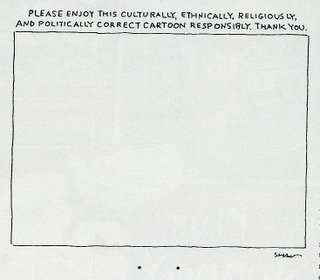
With all that said, I'd be neglectfully ignorant if I didn't recognize the value of journalists and bloggers to be unobtrusive, sensitive and tasteful. The freedom to be offended is implied in freedom of speech, and free speech applies to the offenders and the offended. In the short term, all those efforts to safeguard save writers, publishers and readers lots of headaches.
So here comes the dilemma again. Which is better: editing for across the board "equality" or including the "unequal" differences by which define ourselves? Which causes more offense, and which causes more social ills?
I'm still not sure.
So let's take another crack at this.
About a week or so ago, my Tuesdays friend and I were talking via AOL instant messenger. We're both juniors in college - he's at the University of Minnesota - who are sunk into our majors but are unsure about our future worth to society as professionals. The questionable worth of our chosen trades (graphic design and journalism) and education was the topic of conversation that night. "Tuesday" was telling me that his non-graphic design electives were preparing him better for grown-up life than courses meant to train him for the real world.
Specifically, Tues. referred to his Poetry in Rap classes. According to the university course description, the class series studies the poetry used in rap, African American literature and American culture. (He took the course described in the link last year; now he's the advanced class.) Obviously, it is well outside the required training to be a graphic designer.
He was telling me that the things he's learned in these classes would actually help him be a mildly influential member of society, not one that "just makes logos." That's when this gem of a concept came up:
Everyone is racist and/or prejudice. And the world would be a better place if everyone - the powerful elite and poor underbelly - would openly admit it.That's the idea that started my faulty post. (Maybe I should start listing Tuesday as contributor to this blog, magazine-style.)
Americans would become better people if they recognized and admitted their racism. Sounds radical, really, since judging people on the basis of race or ethnicity usually is considered a bad trait. But here's my interpretation:
Everyone - whites and people of color - is different, thus, by default, everyone holds prejudices. Like it or not, factors such as race, ethnicity, sexuality and age act as divisions for social self-identification. Rather than pretending such identifying characteristics don't exist, people should recognize and embrace them. Lumping everyone into one group can perpetuate inequalities and stereotypes as much as explicit discrimination.Which is what I thought while reading that handout in my newspaper editing lecture. Robert Maynard likened the identifying factors of race/ethnicity, gender, age, class and geography to the geological faults that cause earthquakes. Here's his quote again:
"The society is split along five faults, and we try in vain to paper them over, fill them in or pretend they aren't there. ... (These) underlying forces, like those in the center of the earth, will thwart us until we come to see out differences as deep, but completely natural things, as natural as geologic fault lines. We don't have to resolve our differences. We can agree to disagree."As previously posted, I'm on board with Maynard. But I don't think his agree to disagree philosophy is correctly applied. Or maybe its not applied at all for that matter. Efforts to be politically correct or tasteful are often so over done that the faults are glossed over, painting the picture that everyone is homogeneous and equal. Taking out the identifying characteristics results in bland and inaccurate writing.
Just by chance, I saw this cartoon in the Feb. 27 issue of The New Yorker. I realize that it's actually a commentary on the cartoon of the Prophet Muhammad, but it kind of conveys my point.
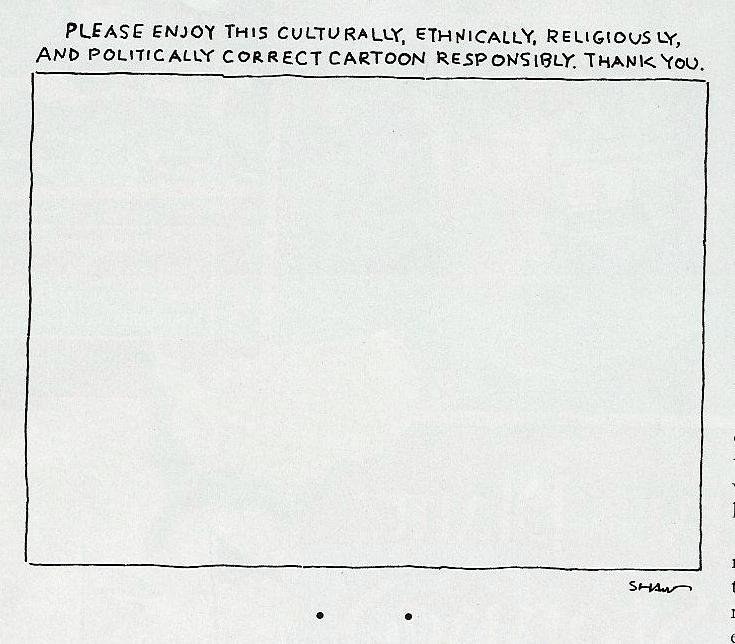
With all that said, I'd be neglectfully ignorant if I didn't recognize the value of journalists and bloggers to be unobtrusive, sensitive and tasteful. The freedom to be offended is implied in freedom of speech, and free speech applies to the offenders and the offended. In the short term, all those efforts to safeguard save writers, publishers and readers lots of headaches.
So here comes the dilemma again. Which is better: editing for across the board "equality" or including the "unequal" differences by which define ourselves? Which causes more offense, and which causes more social ills?
I'm still not sure.
Monday, February 27, 2006
double fault
"The most important part is keeping our eyes on the master metaphor of the Fault Line. The society is split along five faults, and we try in vain to paper them over, fill them in or pretend they aren't there. ... (These) underlying forces, like those in the center of the earth, will thwart us until we come to see out differences as deep, but completely natural things, as natural as geologic fault lines. We don't have to resolve our differences. We can agree to disagree." ~Robert C. MaynardThat quote was on a handout from my newspaper editing class. We were talking about editing for taste and style when the concept of these five faults - race/ethnicity, gender, generation, class, geography - came up. The idea is that society is shaped based on these underlying characteristics. From my interpretation of Maynard's quote, journalists need to recognize these divisions in order to write tastefully and un-offensively.
There's nothing wrong with that, as far as I'm concerned. But I think it can be over-applied. Trying so hard not to offend actually perpetuates the prejudices those fault lines address. No, someone's race, gender or age isn't always relevant to any story, but I think more often than not, it is. Those fault lines are the basic characteristics for self-definition. Leaving that kind of information out implies that all people are the same, and, well, they aren't.
That said, I understand the effort of journalists, and maybe bloggers, too, to be unobtrusive, tasteful, ultimately politically correct. In the short term, it saves everyone from a huge headache. But maybe in "agreeing to disagree," we should start celebrating those differences that Maynard says we don't have to resolve. There's value in respecting one's identity, too, and I'm pretty sure there are ways to do that tastefully.
So what's better, editing out potentially offensive fault-line characteristics, or including self-identifying fault-line characteristics? I honestly don't know. Any suggestions?
Subscribe to:
Posts (Atom)

